If you woke up today feeling like a freight train just barreled through your living room, you aren't alone. It’s becoming a weirdly common vibe in the Garden State lately. Honestly, for a place that isn't exactly San Francisco, we've had a busy start to the year. Just this afternoon, January 14, 2025, people across North Jersey and even parts of New York City started blowing up social media asking that same old question: "Did we just have an earthquake?"
The short answer? Yeah.
The United States Geological Survey (USGS) confirmed a minor tremor hit the region today. It wasn't a massive, world-ending event, but it was enough to make the coffee in your mug do that Jurassic Park ripple thing. This follows a string of seismic activity that has left residents from Paramus down to Califon wondering if the ground beneath them is ever going to just... chill.
What Happened With the New Jersey Earthquake Today?
Today's shake was centered in Northern New Jersey, roughly in the same neighborhood that’s been active all month. Early reports from the USGS suggest a magnitude in the low 2s, which is basically the seismic version of a polite "excuse me" from the earth. But here's the thing: in the Northeast, the bedrock is incredibly old and hard. It’s basically a giant granite sounding board.
Because of that rock density, even a tiny 2.4 or 2.1 magnitude quake travels way further than it would in California's "softer" soil. That’s why someone in a high-rise in Jersey City or a brownstone in Brooklyn can feel a rumble that technically started miles away in a quiet suburb.
You’ve probably heard people describe it as a loud "boom" or a sudden jolt. That’s because these quakes are often shallow. When they happen just 4 or 5 miles down, the energy doesn't have much time to dissipate before it hits the surface. It’s less of a rolling wave and more of a sharp, vertical kick.
The Numbers: 2025 vs. The "Big One" of 2024
Everyone is still comparing every little vibration to that 4.8 magnitude quake from April 2024. That one was a beast—it was the strongest the state had seen in over 200 years. To give you some perspective, that 4.8 released about 4,000 times more energy than the little 2.4 magnitude jolts we've been seeing this month.
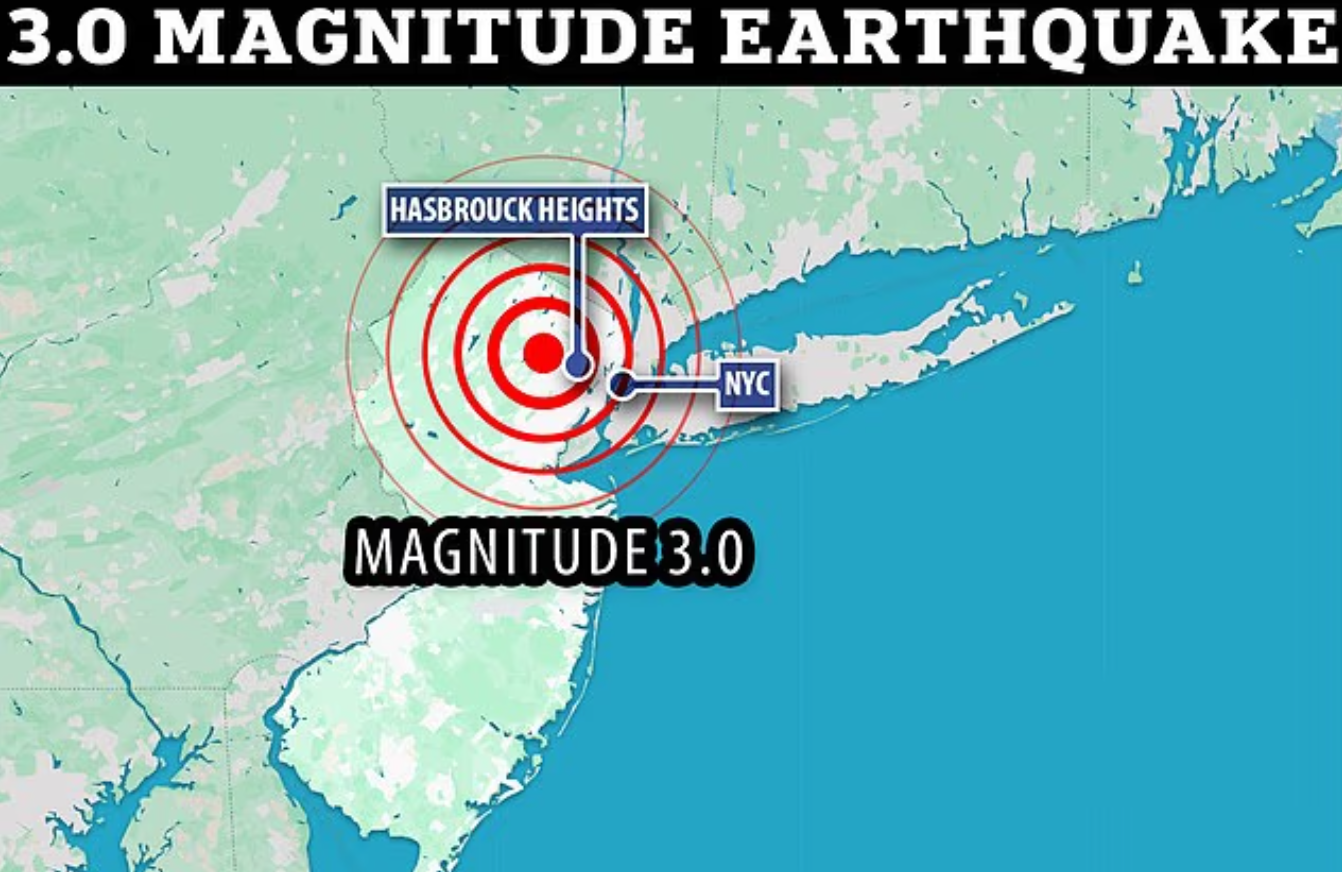
Still, having multiple tremors in a single week—like we did back in August 2025 when quakes hit Hasbrouck Heights (3.0 magnitude) and Hillsdale (2.7 magnitude) back-to-back—makes it feel like something is brewing. Geologists like John Bellini from the USGS often remind us that the Northeast has dozens of small faults. Most of them don't even have names. They just sit there for decades and then, for no obvious reason, they decide to settle a bit.
Why Jersey? The Ramapo Fault and New Discoveries
Most people point the finger at the Ramapo Fault. It’s the "famous" one that runs through New Jersey, New York, and Pennsylvania. But it's not the only player. After the 2024 shake, scientists actually identified a "new" fault—the Mountainview Fault.
It’s kind of wild to think about. We’ve lived on this land for hundreds of years, built highways and shopping malls over it, and we're still finding giant cracks in the foundation we didn't know were there.
Northern Jersey is basically a patchwork quilt of these ancient faults. They aren't "active" in the way the San Andreas is, meaning they aren't constantly sliding. Instead, they’re more like old, rusty hinges. They stay stuck for a long time, and then—creak—they move an inch.
- April 2024: 4.8 magnitude, Tewksbury. Felt by 42 million people.
- August 3, 2025: 3.0 magnitude, Hasbrouck Heights. Rattled NYC nerves.
- August 5, 2025: 2.7 magnitude, Hillsdale.
- January 24, 2025: 2.4 magnitude, Paramus. Felt as far as the Bronx.
- Today, January 14, 2026: Minor tremors continue to pop up near the same fault lines.
Is This the "New Normal"?
Honestly, it feels like it. But "normal" is a relative term. Before 2024, if you told a New Jerseyan to prepare for an earthquake, they’d laugh at you. Now, people are actually checking where their gas shut-off valves are.
The good news is that these 2.0 to 3.0 magnitude quakes almost never cause structural damage. They might knock a picture frame crooked or make your cat lose its mind for five minutes, but your house isn't going to fall down. The concern, of course, is whether these are foreshocks for something bigger.
Geologists generally say no. In this part of the world, small quakes are usually just small quakes. They aren't always leading to a "Big One." That said, we can’t rule out the possibility of a 5.0 or even a 6.0 magnitude event one day. It’s rare, but the historical record says it can happen.
What to Do When the Ground Starts Moving
If you felt the New Jersey earthquake today, you’ve probably already done the first step: check Twitter (or X) to see if you’re crazy. But if the shaking gets serious, the "Drop, Cover, and Hold On" rule is still the gold standard.
- Drop to your hands and knees so the quake doesn't knock you over.
- Cover your head and neck. If there’s a sturdy table nearby, crawl under it.
- Hold On to your shelter until the shaking stops.
Don't run outside. That’s a common mistake. Most injuries in earthquakes happen when people try to leave a building and get hit by falling glass or masonry from the exterior. Just stay put.
If you're in a car, pull over to a clear area. Avoid bridges and power lines. It’s pretty basic stuff, but when the floor starts acting like a trampoline, basic logic tends to fly out the window.
Actionable Next Steps
If you’re living in the "quaking zone" of North Jersey, there are a few practical things you should actually do. Don’t just read the news and worry.
First, secure your heavy furniture. If you have a massive bookshelf that isn't bolted to the wall, today is a good day to buy some L-brackets. In a minor quake, those things can tip.
Second, know where your utility shut-offs are. If a larger quake hits, the real danger is often fire from broken gas lines. Make sure you know how to turn off the gas and water.
Third, contribute to citizen science. If you felt it today, go to the USGS "Did You Feel It?" website and submit a report. It helps geologists map exactly how the energy travels through our specific type of soil and rock, which helps improve building codes and emergency responses.
Lastly, keep an emergency kit. It doesn't have to be a "doomsday prepper" basement full of canned beans. Just a few gallons of water, a flashlight with working batteries, and a first-aid kit in an easy-to-grab bag.
New Jersey might not be the next California, but the earth is clearly trying to tell us something. It’s better to be the person with a flashlight and a plan than the person standing in the dark wondering why the bookshelf is on the floor.