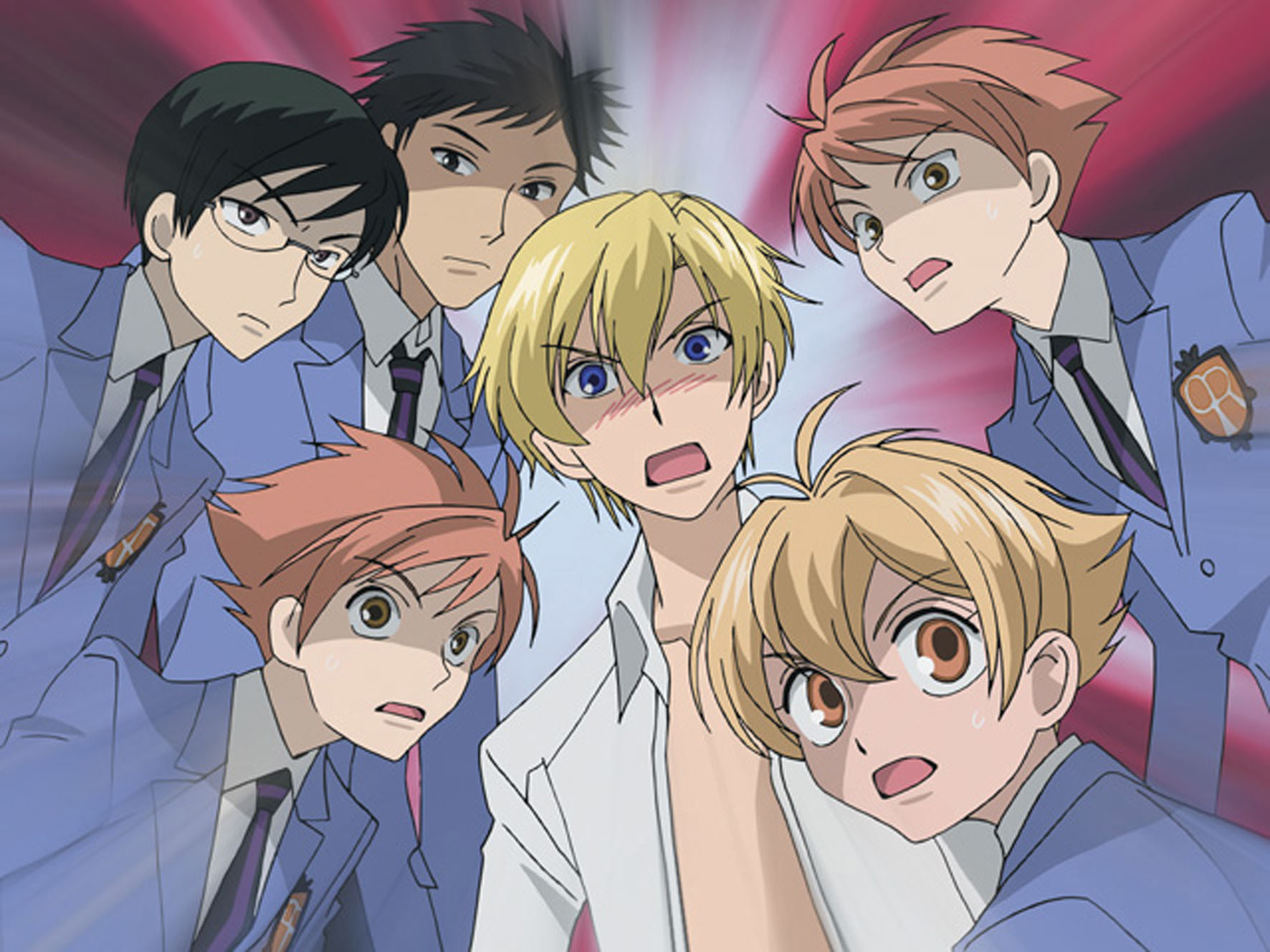
You’ve probably seen the meme. A group of impossibly handsome boys in purple blazers, a rose-petal background, and that infectious "Kiss Kiss Fall in Love" opening theme. If you spent any time on the internet in the mid-2000s, Ouran High School Host Club was basically inescapable. It’s one of those rare anime properties that managed to transcend its "shoujo" (young girl) demographic to become a cultural touchstone for an entire generation of fans. But here’s the thing most people miss: Ouran isn't just a romance. It’s a ruthless, brilliant parody of the very genre it belongs to.
It’s about Haruhi Fujioka. She’s a scholarship student at the elite Ouran Academy, surrounded by the kind of wealth that feels borderline fictional. While looking for a quiet place to study, she stumbles into Music Room #3—the headquarters of the Host Club. Within minutes, she accidentally breaks an 8-million-yen vase. To pay off the debt, she’s forced to work as a "dog" for the club, eventually becoming a host herself because, honestly, she’s got a natural charm that the girls at the school can't resist. And because she doesn't care about gender norms, she just rolls with it.
The Genius of Bisco Hatori’s Subversion
Bisco Hatori, the creator of the manga, knew exactly what she was doing. By 2002, when the manga first started in LaLa magazine, the "reverse harem" trope was getting stale. You know the one—one girl, six guys, lots of pining. Hatori took every tired cliché and cranked it up to eleven.
Tamaki Suoh is the perfect example. He’s the "King." On the surface, he's the quintessential princely character. He's dramatic. He's rich. He’s devastatingly handsome. But the show constantly treats him like an absolute idiot. The anime, produced by Studio Bones and directed by Takuya Igarashi, uses visual gags—like Tamaki growing mushrooms in a dark corner when he’s depressed—to deflate the ego of the traditional male lead. It’s self-aware. That’s the secret sauce.
Most shows in this genre want you to take the romance seriously. Ouran wants you to laugh at how ridiculous the romance is, right before it hits you with a genuine emotional gut-punch. It’s a balancing act that most modern shows still struggle to pull off. Think about the "Shadow Girl" transitions or the way the show uses a literal "Rich People’s Logic" filter. It’s mocking the elitism of its own setting while making us fall in love with the characters.
Haruhi Fujioka and the Deconstruction of Gender
Haruhi is arguably one of the most important protagonists in anime history.
Why? Because she doesn't care.
In a world obsessed with labels, Haruhi’s stance on her own gender identity is refreshingly modern for a series that’s over two decades old. She famously says, "In my opinion, it’s more important for a person to be recognized for who they are rather than what gender they are." This wasn't a political statement in the way we see them today; it was just her character’s core truth. She’s pragmatic. She’s poor. She doesn't have the luxury of worrying about the "surface-level" nonsense the Host Club obsesses over.
This creates a fascinating dynamic. The boys are essentially performing "types" to satisfy the fantasies of their clients. You have the "cool" type (Kyoya), the "lool" type (Honey), the "mischievous" twins (Hikaru and Kaoru), and the "strong-silent" type (Mori). They are aware they are playing roles. Haruhi is the only one who is authentically herself, and that’s exactly why every single one of them is drawn to her. She is the "straight man" in a comedy of errors, the anchor in a sea of rose petals and expensive tea.
The Kyoya Ohtori Factor: Business or Pleasure?
Let’s talk about Kyoya. If Tamaki is the heart of the club, Kyoya is the brain. He’s the one who actually makes the club profitable.
In the real world, "host clubs" are a legitimate part of Japanese nightlife, particularly in districts like Kabukicho in Tokyo. They are businesses built on the sale of companionship and fantasy. Ouran takes this concept and transplants it into a high school setting, which is inherently absurd, but Kyoya treats it with the seriousness of a Fortune 500 merger.
He’s often seen as the "Shadow King." His relationship with Tamaki is the most complex one in the show. Kyoya comes from a family where he’s the third son, constantly feeling the pressure to outperform his older brothers. He views life through a lens of merit and cost-benefit analysis. Tamaki is the only person who forces him to act on impulse, to do something "pointless" just because it’s fun. It’s a brilliant exploration of the pressures of the Japanese patriarchy and the burden of expectation.
Why There’s No Season 2 (And Why That’s Okay)
Fans have been screaming for a second season since the anime ended in 2006. It’s been twenty years. The anime covers roughly the first half of the manga, ending on a beautiful, if somewhat original, note at the school festival.
The manga goes much deeper.
In the source material, we get the full backstory of the twins’ mother, a famous fashion designer. We see the actual resolution of the Haruhi and Tamaki romance, which involves a move to France. We see the characters actually grow up.
So, why no reboot? Studio Bones has been busy with massive hits like My Hero Academia and Bungo Stray Dogs. Plus, the original voice cast—featuring titans like Mamoru Miyano and Maaya Sakamoto—is legendary. Recreating that magic is risky. Sometimes, a "perfect" 26-episode run is better than a dragged-out revival that loses the spark. Though, with the recent trend of re-adapting classics like Fruits Basket and Rurouni Kenshin, the door isn't entirely shut.
The Cultural Impact: More Than Just "Shipping"
Ouran High School Host Club helped bridge the gap between "hardcore" anime fans and casual viewers. It was a "gateway drug."
- Cosplay: Go to any convention today, and you will still see those blue blazers. It’s an easy, recognizable outfit that signifies you’re part of a specific community.
- The Soundtrack: The jazz-infused score by Yoshihisa Hirano is top-tier. It captures the frantic, upscale energy of the school perfectly.
- Fan Fiction: The series remains one of the most written-about on platforms like Archive of Our Own (AO3), proving the characters have a longevity that outlasts their original broadcast.
It’s also worth noting the series’ handling of darker themes. The Hitachiin twins, Hikaru and Kaoru, deal with a level of codependency that is genuinely unsettling at times. Their "brotherly love" act is a facade for a deep-seated fear of being separated or misunderstood by the outside world. When Haruhi enters their lives, she disrupts their "world of two," forcing them to develop individual identities. It’s a sophisticated look at childhood trauma and social isolation, hidden behind a layer of slapstick comedy.
How to Experience Ouran Today
If you’re coming to this for the first time, or if you’re a returning fan, you need to look past the sparkles.
Watch the sub for the incredible comedic timing of Mamoru Miyano. Watch the dub—which is widely considered one of the best English dubs of all time—for J. Michael Tatum’s iconic performance as Kyoya and Caitlin Glass’s perfect, grounded Haruhi.
Honestly, the show holds up because the writing is tight. It doesn't waste time. Every episode, while ostensibly a "monster of the week" (or "client of the week") format, moves the character development forward. You start for the tropes, but you stay because these kids are actually trying to figure out who they are in a world that has already decided their futures for them.
Actionable Insights for the Modern Fan:
- Read the Manga: If you’ve only seen the anime, you’re missing the actual ending. The manga (volumes 1-18) provides the closure the anime lacks, especially regarding the Eclair Tonnerre arc which was mostly an anime-only invention.
- Analyze the Satire: Try watching an episode and identifying which specific shoujo trope is being mocked. Whether it’s the "accidental trip and fall" or the "dramatic rain scene," the show is usually making a point about how silly these conventions are.
- Check Out the Live Action: There is a Japanese live-action drama and a film. They are... chaotic. They lean even harder into the "cartoonish" energy of the manga. It’s an acquired taste but worth it for the completionist.
- Support Official Releases: The series is frequently available on platforms like Crunchyroll or Hulu. Keeping the view counts high is the only real way to signal to studios that there is still interest in a potential "Brotherhood-style" reboot.
Ouran High School Host Club isn't a relic of the past. It’s a masterclass in how to write a parody that has heart. It tells us that wealth is boring, but people are fascinating. It tells us that gender is a performance, but kindness is universal. Most importantly, it tells us that even if you break an 8-million-yen vase, you might just find where you belong.