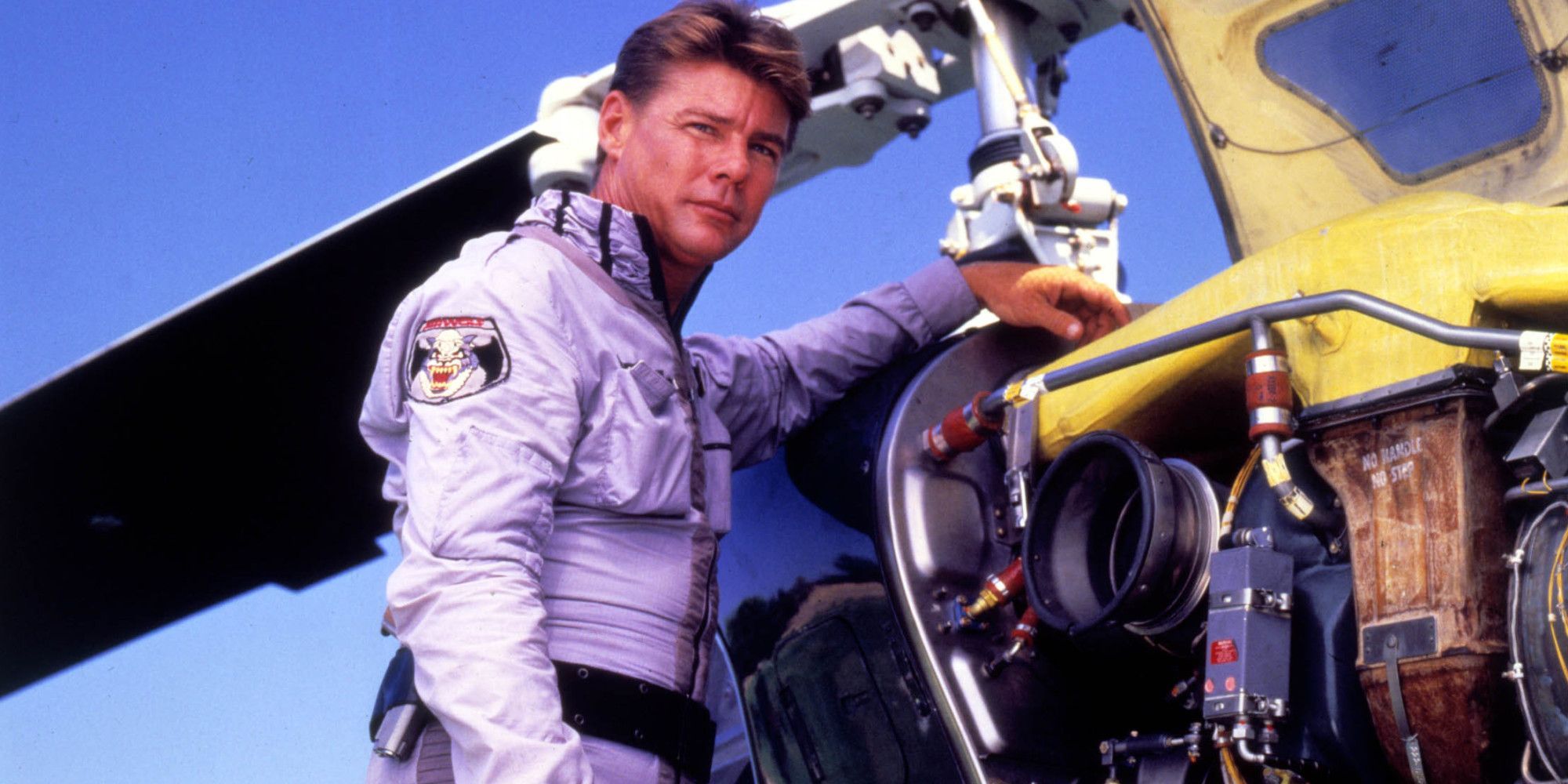
Jan-Michael Vincent was once the highest-paid actor on television. He wasn't just a star; he was the face of 1980s high-octane action. If you owned a TV between 1984 and 1986, you knew Stringfellow Hawke. You knew the brooding pilot who lived in a mountain cabin, played the cello to eagles, and flew a supersonic helicopter that made the Apache look like a toy.
But the story of Jan Michael Vincent Airwolf is kinda tragic. It’s a tale of a man who had the world at his feet—earning a staggering $200,000 per episode—only to have it all crumble under the weight of personal demons and production chaos.
The $200,000 Pilot: Why Airwolf Was a Massive Risk
In 1984, $200,000 per episode was unheard of. To put that in perspective, that’s roughly $600,000 in 2026 money. CBS was betting the farm on Vincent. They needed a leading man who could balance "rugged action star" with "sensitive soul," and Vincent, with his sun-bleached hair and quiet intensity, fit the bill perfectly.
He played Stringfellow Hawke, a man obsessed with finding his brother, St. John, who was MIA in Vietnam. It gave the show a weirdly somber emotional core for a series about a "Lady" (the helicopter) that blew things up.
Honestly, the chemistry between Vincent and the legendary Ernest Borgnine, who played Dominic Santini, was the only reason the show lasted as long as it did. Borgnine was the boisterous uncle to Vincent’s quiet, tortured nephew. While the helicopter was the gadget that sold toys, the human relationship sold the drama.
What Went Wrong with Jan Michael Vincent and Airwolf?
Success is a double-edged sword. While the show was a hit, Vincent was struggling. Heavily. It wasn't a secret on set that he was battling alcoholism and drug use. By the second and third seasons, the "brooding" look that fans loved was sometimes just the visible toll of a rough night.
- The Production Costs: Every episode cost about $1 million to produce. Most of that went to the helicopter sequences and Vincent’s salary.
- Erratic Behavior: Reports from the set suggested Vincent was increasingly difficult to work with. He’d miss cues or show up in no condition to fly—not even in a gimbal-mounted cockpit on a soundstage.
- The CBS Ultimatum: By the end of Season 3, the ratings were dipping. CBS told the producers they wouldn't renew the show unless Vincent was gone.
Here is the kicker: Vincent actually owned a small percentage of the show. When the network demanded his exit, it created a legal and financial mess. Instead of fixing the issues, CBS simply pulled the plug.
The "Season 4" Disaster
What happened next is a masterclass in how not to reboot a show. The production moved to Canada, the entire original cast was fired, and they "killed off" Stringfellow Hawke in a senseless explosion. They replaced Vincent with Barry Van Dyke (playing the long-lost brother St. John).
Fans hated it.
Because they didn't have the budget for the actual helicopter anymore, they used grainy, recycled stock footage from the Vincent era. It looked cheap. It felt cheap. Without Jan-Michael Vincent, Airwolf lost its soul, and the show was canceled for good shortly after.
Life After the Cockpit: A Downward Spiral
If you look at Vincent's life after 1986, it’s a litany of "what ifs." He did a string of low-budget movies—stuff like Deadly Embrace and Sins of Desire—but the big studios wouldn't touch him.
He survived three horrific car accidents in the 1990s. One in 1996 broke three vertebrae in his neck and permanently damaged his vocal cords. That’s why, in his later years, his voice was a raspy, painful-sounding whisper. He literally lost the voice that had made him a star.
By 2012, things got even worse. He contracted an infection from peripheral artery disease, leading to the amputation of the lower half of his right leg. He spent his final years in North Carolina, largely forgotten by the industry that once paid him millions.
Why We Still Care About Jan Michael Vincent in 2026
It’s easy to focus on the tragedy, but that’s not why people still watch Airwolf marathons. We watch because, for a brief window in the mid-80s, Jan-Michael Vincent was the coolest guy on the planet. He brought a genuine, wounded humanity to a genre that was usually just muscles and explosions.
He wasn't just a pilot; he was a guy who wanted to go home.
Actionable Insights for Fans and Collectors
If you're looking to revisit the legacy of Jan Michael Vincent Airwolf, here is how to do it right:
- Watch Season 1 First: The first season, produced by Donald P. Bellisario (who later did NCIS), is much darker and more sophisticated than the later ones. It's actually a solid spy thriller.
- Skip Season 4: Seriously. Unless you want to see how bad "stock footage" can get, stick to the Jan-Michael Vincent years.
- Check out "Big Wednesday": If you want to see Vincent at his absolute peak before the "Airwolf" era, watch this 1978 surfing cult classic. It shows the actor he could have been.
- Look for the Soundtrack: The Airwolf theme by Sylvester Levay is arguably one of the best synth tracks of the decade. It still holds up.
Jan-Michael Vincent passed away in 2019 at the age of 74. His death wasn't even reported for nearly a month. It was a quiet end for a man who used to roar through the skies. But every time that theme song kicks in and that black-and-white helicopter crests a mountain ridge, he’s still the highest-paid star in the world.
To truly understand the show's impact, you should track down the original pilot movie. It’s significantly grittier than the broadcast episodes and shows exactly why Jan-Michael Vincent was considered the next big thing in Hollywood. Focus your collection on the first three seasons to preserve the quality of the legacy.